Home › Blog › How to Improve Focus and Concentration Naturally
Focus & LifestyleHow to Improve Focus and Concentration Naturally
| The short version | You can improve focus and concentration naturally by fixing the everyday basics first — sleep, distractions, food, water and movement — before reaching for anything else. |
| Biggest levers | A full night’s sleep, silenced notifications, steady blood sugar, and focused work blocks with real breaks. |
| Where supplements fit | A daily functional mushroom like Lion’s Mane is a routine add-on, not a replacement for good habits. |
| Realistic timeline | Some changes help the next day; a routine is best judged over several weeks. |

If you sit down to work and your attention scatters within minutes, you are not broken and you are not alone. The ability to improve focus and concentration naturally is less about willpower and more about removing the everyday things that quietly pull your attention apart. In this guide we walk through why concentration slips in the first place, then lay out the daily habits, foods and routines that help you settle in and stay there — the sort of practical, no-hype changes anyone can start this week.
Why concentration slips in the first place
Before you can improve focus, it helps to understand what erodes it. Most people assume they simply lack discipline, but the truth is usually more mechanical. Your brain is doing exactly what it evolved to do — scan for anything new or urgent — and modern life gives it an endless supply of interruptions. When you name the causes, the fixes become obvious.
Sleep debt is the silent focus killer
Nothing degrades concentration faster than short or broken sleep. After a poor night, the parts of the brain responsible for holding attention and filtering distractions simply do not work as well. If you are running on six hours and wondering why you cannot concentrate, that is very likely your answer. Sleep is the single highest-leverage habit on this entire list, which is why we cover it in depth in our guide to how sleep affects memory and focus. Sleep research describes overnight consolidation and attentional restoration as active processes, which is why a short night reads as a scattered morning Rasch B et al. (Physiol Rev, 2013).
Digital distraction and context-switching
Every notification, every quick glance at a phone, every tab you flick to costs you more than the few seconds it takes. Each switch forces your brain to reload what you were doing, and that reloading tax adds up across a day. Many people who feel they “can’t focus” are actually focusing perfectly well — just on a dozen different things in rapid succession. A study of heavy media multitaskers found they were measurably worse at ignoring irrelevant information and at switching between tasks Ophir E et al. (Proc Natl Acad Sci U S A, 2009).
Blood-sugar swings and skipped meals
Your brain runs on a steady supply of glucose. Skip breakfast, then crash on a sugary snack, and you get a rollercoaster of energy that makes deep concentration almost impossible. Steady, balanced meals keep the fuel line even.
Dehydration and stress
Even mild dehydration can leave you foggy and irritable, and chronic stress keeps your mind busy with background threat-scanning that leaves little bandwidth for the task in front of you. Both are common, both are fixable, and both are covered more fully in our piece on what causes brain fog and how to clear it.
How to improve focus and concentration naturally: the daily habits that work
Here is the practical core of this guide. None of it is exotic, and that is the point — the habits that reliably improve focus and concentration naturally are the ones you can repeat every single day without much thought.
1. Protect your sleep like it is part of the job
Aim for a consistent bed and wake time, keep the last hour before bed screen-light, and treat seven to nine hours as non-negotiable rather than optional. A single good night can noticeably sharpen your attention the following day.
2. Work in focused blocks with real breaks
Instead of grinding for hours, try working in defined blocks — many people like around 25 to 50 minutes — followed by a genuine break away from the screen. This rhythm matches how attention naturally rises and fades, and it makes long stretches of concentration far more sustainable. In a randomised study, two weeks of brief daily mindfulness training improved working-memory capacity and reduced mind-wandering during a reading task Mrazek MD et al. (Psychol Sci, 2013).
3. Remove the phone from the room
Willpower is no match for a device engineered to capture attention. Silence non-essential notifications, and during a focus block, put the phone in another room entirely. Out of sight really does mean out of mind here. The wider case is laid out in our guide to how screen time affects your focus and brain.
4. Eat for steady energy
Build meals around protein, fibre and healthy fats so your energy stays even, and do not skip breakfast on a day you need to concentrate. We go deeper on this in our roundup of the best foods for memory and brain health.
5. Move your body every day
A brisk walk, a short workout, even a few minutes of movement between tasks increases blood flow and tends to leave the mind clearer for the work that follows. Exercise is one of the most consistently helpful things you can do for daytime concentration. See how exercise boosts your brain and memory for what movement changes over weeks rather than minutes.
6. Hydrate before you caffeinate
Many mid-morning slumps are thirst in disguise. A glass of water first thing, and steady sips through the day, keeps a common and avoidable drag on focus off the table. And if coffee is doing the heavy lifting in your day, read how caffeine affects your focus and brain before you add another cup.
Where a daily supplement fits in
Once the basics are in place, some people like to add a daily supplement to their focus routine. This is where Lion’s Mane (botanical name Hericium erinaceus) tends to come up. It is an edible functional mushroom with a long history in East Asian cooking and traditional wellness, and it has become one of the most popular single ingredients in the modern nootropic aisle for people who want a simple, non-stimulant daily habit.
It is worth being clear about what a supplement is and is not. Lion’s Mane is a food-derived supplement, not a drug, not a stimulant, and not a substitute for sleep, food or movement. The people who are happiest with it treat it as one steady habit stacked on top of the fundamentals — not a shortcut around them. If you are curious about the mushroom itself, our explainer on what Lion’s Mane does for your brain covers the compounds people talk about and how it is typically used.
Want a simple daily focus habit?
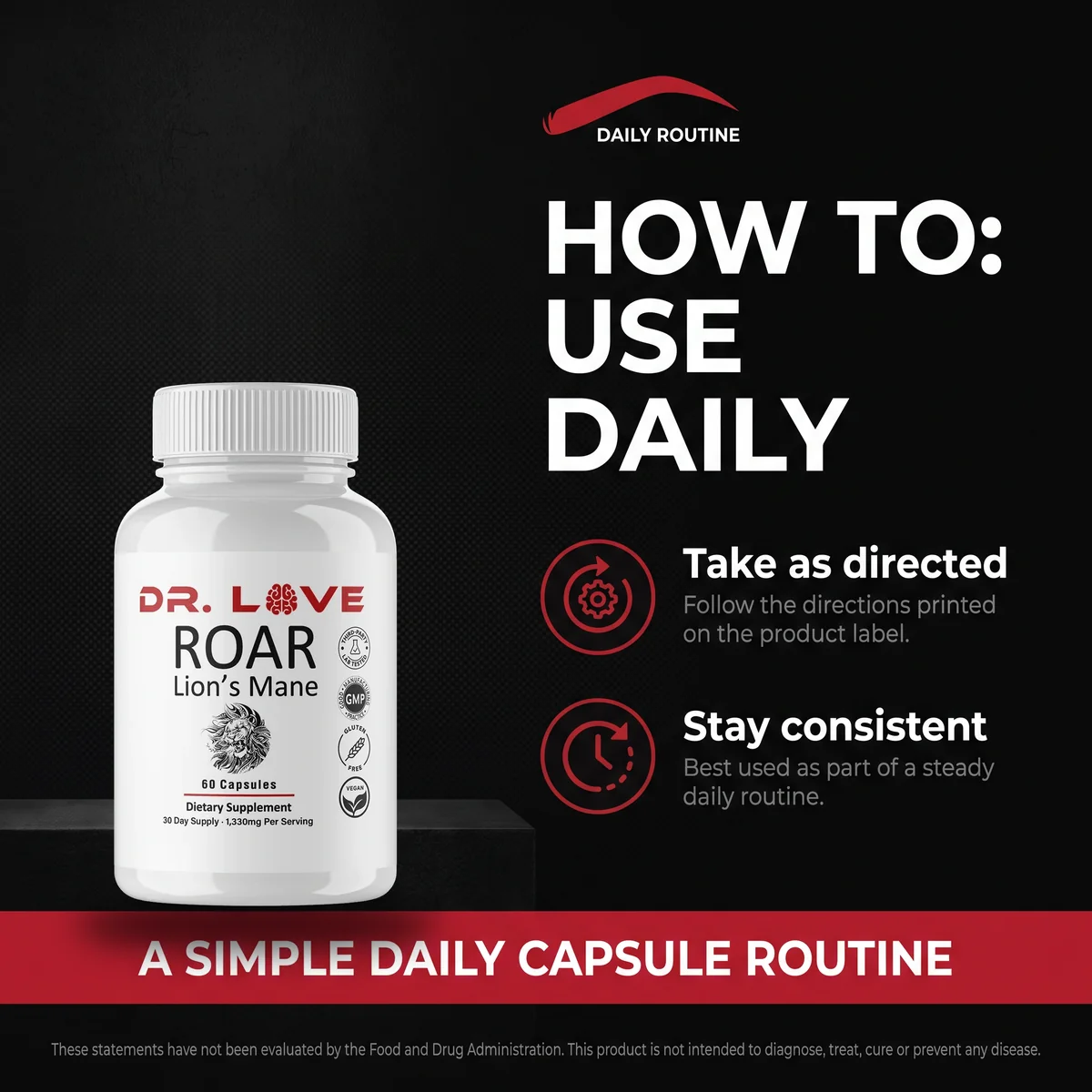
Roar Lion’s Mane is a single-ingredient capsule — 1,330 mg of Lion’s Mane a day, no stimulants, no fillers — backed by a 180-day money-back guarantee.

Building a focus-friendly day, hour by hour
It can help to picture how these habits fit together across an ordinary day rather than as a scattered checklist. Here is one realistic shape:
- Morning: A glass of water on waking, a protein-forward breakfast, and your daily supplement taken with that meal so you never forget it. Save the phone until after you have started your first real task.
- Mid-morning: Your hardest, most demanding work in a focused block while your energy is high, phone out of the room, notifications off.
- Midday: A proper lunch and a short walk outside to reset attention for the afternoon.
- Afternoon: Lighter, more forgiving tasks grouped together, with water nearby and a short movement break if the familiar slump arrives.
- Evening: A wind-down that protects tomorrow’s focus — dimmer light, less screen time, and a consistent bedtime.
Notice that the supplement is a small, fixed part of the picture. The heavy lifting is done by sleep, food, movement and distraction control. If your afternoons in particular are a struggle, our guide on why you feel mentally tired all the time digs into the recovery habits that help.
Common mistakes that keep focus low
Plenty of people do the hard things and still struggle, usually because of a few avoidable traps:
- Relying on more and more caffeine. A stimulant can paper over tiredness for a while, but it cannot replace the sleep you are missing, and too much late in the day undermines that very sleep.
- Trying to multitask. Doing two demanding things at once means doing both worse. Single-tasking is the faster route.
- Expecting instant results from a supplement. Anything you take as a daily habit is best judged over weeks of consistency, not a single dose.
- Ignoring the basics and hoping a product fixes everything. No capsule outperforms a full night’s sleep and a distraction-free hour.
FAQ
Why is my concentration so bad lately?
Poor concentration usually has an everyday cause rather than a single dramatic one. Broken sleep, constant phone notifications, blood-sugar swings from skipped or sugary meals, dehydration and unmanaged stress are the most common culprits. Fixing the basics one at a time is more effective than chasing a quick fix.
How can I improve my focus naturally without caffeine?
Protect your sleep, work in focused blocks with real breaks, silence non-essential notifications, stay hydrated, eat steady protein-and-fibre meals, and move your body daily. Some people also add a daily functional-mushroom supplement such as Lion’s Mane as part of that routine.
Does Lion’s Mane help with focus?
Lion’s Mane (Hericium erinaceus) is a functional mushroom that many people take daily as part of a focus-friendly routine. It is a food-derived supplement, not a stimulant or a medicine, and it should be used alongside good habits rather than in place of them. Individual experiences vary.
How long does it take to improve focus?
Some habits, such as silencing notifications and getting a full night of sleep, can help the very next day. Others, like a consistent routine or a daily supplement, are best judged over several weeks of steady practice. Individual results vary and are not guaranteed.
Can I take Lion’s Mane every day?
Lion’s Mane is generally used as a daily supplement. Follow the directions on the product label — for Roar Lion’s Mane that is two capsules a day — and consult your physician if you are pregnant, nursing, under 18 or taking medication.
References
- Rasch B et al. “About sleep's role in memory.” Physiol Rev, 2013. PubMed 23589831
- Ophir E et al. “Cognitive control in media multitaskers.” Proc Natl Acad Sci U S A, 2009. PubMed 19706386
- Mrazek MD et al. “Mindfulness training improves working memory capacity and GRE performance while reducing mind wandering.” Psychol Sci, 2013. PubMed 23538911
- National Heart, Lung, and Blood Institute. “Sleep Deprivation and Deficiency.” www.nhlbi.nih.gov
- NIH Office of Dietary Supplements. “Dietary Supplements: What You Need to Know.” ods.od.nih.gov
The Roar Lion’s Mane Research Team is an independent group that writes plain-English guides on nootropics, functional mushrooms and everyday brain-health habits. We read the primary literature, avoid hype, and are careful to separate what is well established from what is still being studied. Our articles are reviewed for accuracy before publication and are intended as general information, not medical advice.
† These statements have not been evaluated by the Food and Drug Administration. This product is not intended to diagnose, treat, cure or prevent any disease. This article is for general information only and is not medical advice. Affiliate disclosure: Roar Lion’s Mane is an independent guide, not the manufacturer or seller. Some links on this page are affiliate links and we may earn a commission at no extra cost to you if you buy through them.