Home › Blog › What Does Lion’s Mane Do for Your Brain?
Nootropic GuideWhat Does Lion’s Mane Do for Your Brain? A Plain-English Guide
| What it is | Lion’s Mane (Hericium erinaceus) is an edible functional mushroom, not a drug or stimulant. |
| Why people take it | As a daily habit for focus, memory and general mental clarity. |
| How much | Common daily amounts sit around 1,000–3,000 mg. Roar provides 1,330 mg per serving. |
| Best approach | Take it consistently and choose a clean, single-ingredient product. |
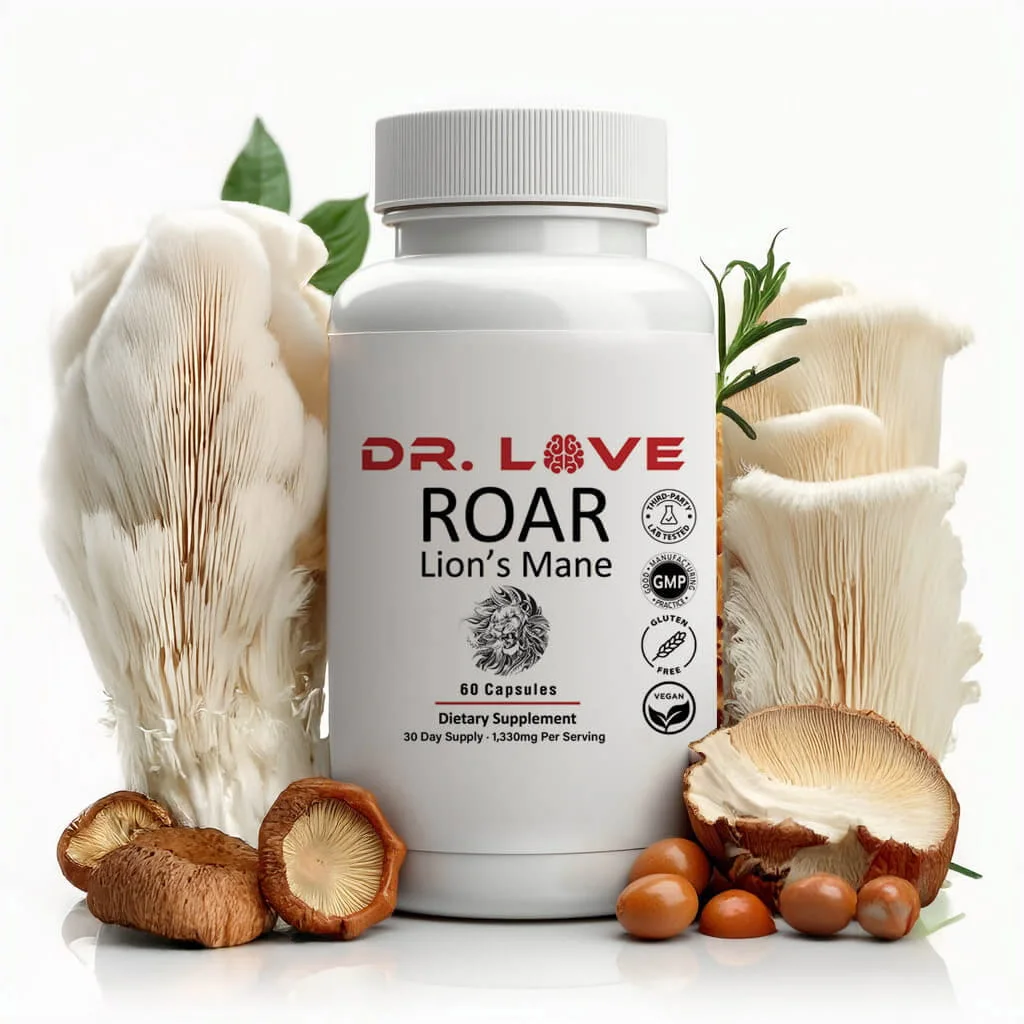
Lion’s Mane has quietly become the poster child of the “nootropic” aisle — the shaggy white mushroom you now see on café menus, in coffee blends and, of course, in capsules. But behind the hype, what does it actually do? This is a plain-English walk through what Lion’s Mane is, the compounds people get excited about, how it’s typically used, and how to pick a product worth your money.
What is Lion’s Mane, exactly?
Lion’s Mane (botanical name Hericium erinaceus) is an edible mushroom that grows in cascading white spines rather than the classic cap-and-stem shape. It has a long history in East Asian cooking and traditional wellness, where it was eaten as food long before it ever appeared in a supplement bottle. That food-first heritage is part of the appeal: it is a whole mushroom, not a synthesised chemical.
In the modern nootropic world it gets grouped with “functional mushrooms” — mushrooms taken for reasons beyond simple nutrition. Lion’s Mane is the one most closely associated with the brain, which is why it tends to headline focus and clarity formulas.
The compounds behind the buzz
When researchers look at Lion’s Mane, three groups of natural compounds come up again and again: A food-chemistry review catalogues these compounds in both the fruiting body and the mycelium, and is careful to note that most of the supporting work is laboratory or animal research Friedman M (J Agric Food Chem, 2015).
- Hericenones — found mainly in the fruiting body (the visible mushroom). These are among the compounds most often cited when people discuss why Lion’s Mane is studied for the brain.
- Erinacines — concentrated in the mycelium (the root-like network the mushroom grows from). They are another signature marker of genuine Lion’s Mane material.
- Beta-glucan polysaccharides — the natural fibres that give all mushrooms their structure and are commonly measured as a marker of mushroom quality.
It’s worth being honest here: research into these compounds is ongoing and much of it is early. Lion’s Mane is a supplement, not a medicine, and no responsible source should promise it will treat or cure anything. What we can say is that these are the naturally occurring compounds people are referring to when they talk about the mushroom. If the reason you are looking at mushrooms is a cloudy head, start instead with what causes brain fog and how to clear it.
What people actually use Lion’s Mane for
Ask a hundred Lion’s Mane users why they take it and you’ll hear a consistent theme: they want a simple daily habit that supports the mental side of an ordinary day. In practice that looks like: The human evidence is thin but not absent: a double-blind trial in healthy young adults tested both a single dose and 28 days of supplementation on cognitive and mood measures Docherty S et al. (Nutrients, 2023).
- A capsule taken before focused, heads-down work.
- Support for study sessions or learning a new skill.
- A go-to during creative time, when staying in flow matters.
- Simply keeping a steady daily routine, the same way someone takes a daily vitamin.
Notice what’s missing from that list: dramatic, overnight transformation. Lion’s Mane is best thought of as a background habit rather than a switch you flip. People who are happy with it tend to be the people who take it consistently and keep their expectations grounded. The bigger levers are still the ordinary ones, starting with how sleep affects memory and focus.
Want the simplest way to try it?
Roar Lion’s Mane is a single-ingredient capsule — 1,330 mg of Lion’s Mane a day, nothing else — backed by a 180-day money-back guarantee.
See Roar PackagesHow much Lion’s Mane should you take?
There is no official recommended daily allowance for Lion’s Mane, but everyday supplement amounts commonly land somewhere in the region of 1,000 to 3,000 mg per day, depending on the product and how concentrated it is. The most important thing isn’t hitting a magic number — it’s knowing exactly how much you’re getting. The most-cited human trial used 3 g a day of powdered Lion's Mane for 16 weeks in older adults with mild cognitive impairment, and reported that scores drifted back toward baseline after supplementation stopped Mori K et al. (Phytother Res, 2009).
That’s where a lot of “brain blend” products fall down. They wrap a small amount of Lion’s Mane inside a proprietary blend alongside a dozen other ingredients, so you can’t tell how much mushroom is actually in each serving. A single-ingredient product avoids that problem entirely. Roar Lion’s Mane, for example, states a flat 1,330 mg per two-capsule serving with nothing else in the mix.
How to add Lion’s Mane to your routine
The good news is that Lion’s Mane fits into a normal morning with almost no effort: It works best inside a routine that already covers the basics in our guide to improving focus and concentration naturally.
- Anchor it to a habit you already have. Take it with breakfast, your first coffee, or your other morning supplements so you never forget.
- Take it with water. Capsules go down easily with 6–8 oz of water.
- Be consistent. Because it’s a habit rather than a hit, the people who get the most out of Lion’s Mane are the ones who take it steadily, day after day.
What to look for in a Lion’s Mane supplement
If you decide to try Lion’s Mane, a few label checks will save you from the worst products:
- A clear amount. The label should tell you exactly how many milligrams of Lion’s Mane are in each serving — not hide it in a blend.
- Third-party lab testing. Independent testing is a sign the brand is willing to have its product checked by someone other than itself.
- A clean formula. Fewer fillers, no unnecessary stimulants, and a capsule that matches your diet (Roar uses a vegan HPMC capsule, for instance).
- A real guarantee. A generous money-back window means you can try it with less risk.
None of this is complicated — it just rewards reading the label instead of the marketing. A straightforward, single-ingredient product like Roar Lion’s Mane ticks these boxes by design, which is exactly why the “made simple” approach has become so popular. The same reading habit pays off at the supermarket, which is where our guide to the best foods for memory and brain health picks up.
The bottom line
Lion’s Mane is an edible functional mushroom that people take as a simple daily habit for focus, memory and mental clarity. Its naturally occurring compounds — hericenones, erinacines and beta-glucans — are why it’s so widely studied, though the science is still developing and it should never be treated as a cure for anything. If you want to try it, keep your expectations realistic, take it consistently, and choose a clean product that tells you exactly what’s inside.
FAQ
How long does Lion’s Mane take to work?
Lion’s Mane is a supplement you take consistently rather than a one-off boost. Most people treat it as a daily habit and give it several weeks of steady use. Individual experiences vary and are not guaranteed.
Can I take Lion’s Mane every day?
Lion’s Mane is generally used as a daily supplement. Follow the directions on the product label — for Roar Lion’s Mane that is two capsules a day — and consult your physician if you are pregnant, nursing, under 18 or taking medication.
Does Lion’s Mane contain caffeine?
No. Lion’s Mane is a functional mushroom, not a stimulant, and contains no caffeine. A single-ingredient product like Roar has no added stimulants of any kind.
References
- Friedman M. “Chemistry, Nutrition, and Health-Promoting Properties of Hericium erinaceus (Lion's Mane) Mushroom Fruiting Bodies and Mycelia and Their Bioactive Compounds.” J Agric Food Chem, 2015. PubMed 26244378
- Docherty S et al. “The Acute and Chronic Effects of Lion's Mane Mushroom Supplementation on Cognitive Function, Stress and Mood in Young Adults: A Double-Blind, Parallel Groups, Pilot Study.” Nutrients, 2023. PubMed 38004235
- Mori K et al. “Improving effects of the mushroom Yamabushitake (Hericium erinaceus) on mild cognitive impairment: a double-blind placebo-controlled clinical trial.” Phytother Res, 2009. PubMed 18844328
- NIH Office of Dietary Supplements. “Dietary Supplements: What You Need to Know.” ods.od.nih.gov
- National Center for Complementary and Integrative Health. “Dietary and Herbal Supplements.” www.nccih.nih.gov
† These statements have not been evaluated by the Food and Drug Administration. This product is not intended to diagnose, treat, cure or prevent any disease. This article is for general information only and is not medical advice. Affiliate disclosure: Roar Lion’s Mane is an independent guide, not the manufacturer or seller. Some links on this page are affiliate links and we may earn a commission at no extra cost to you if you buy through them.